

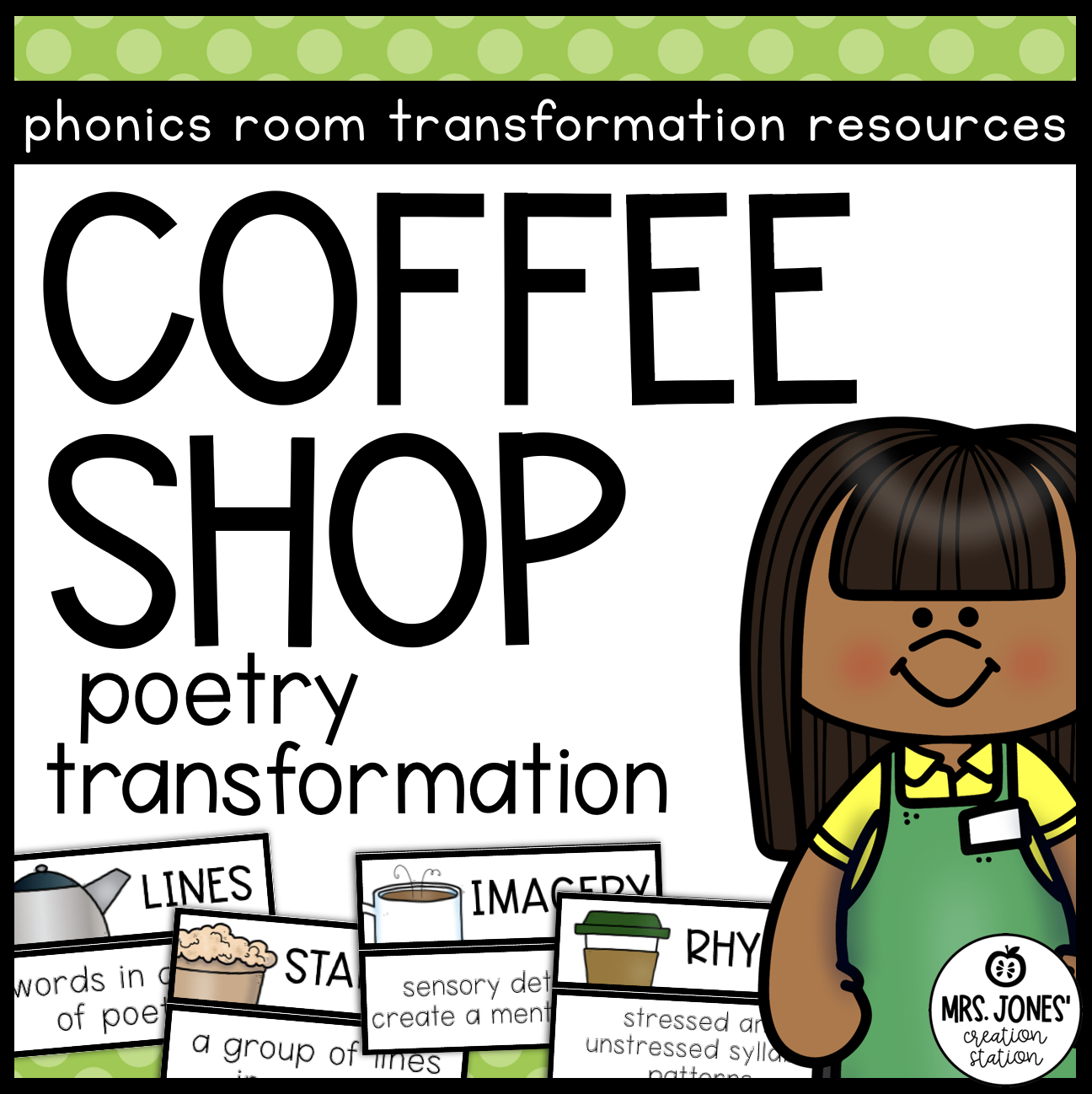

Turn poetry instruction into a Coffee Shop classroom transformation
Welcome to Poetry Pours, where your students become baristas while learning important poetry vocabulary and elements!
This Poetry Classroom Transformation turns your classroom into the Second Grade Street Coffee Shop for an engaging introduction to, or review of, poetry.
Students begin their Barista Training with a poetry vocabulary pre-assessment. Next, you introduce seven important poetry concepts using examples and the coordinating Poetry Pours Coffee Menu. Then, students use what they learned to complete a Coffee Cup Match Up assessment. Finally, successful baristas can create their own name tags to celebrate completing their training.
Students learn about lines, stanzas, rhythm, rhyme, repetition, imagery, and alliteration through explicit instruction and examples from poetry.
As a result, the coffee shop theme gives students a memorable context for learning academic vocabulary without taking the focus away from the actual poetry lesson.
Use the complete resource as a special Second Grade poetry classroom transformation, or use the instructional materials separately throughout your poetry unit.
WHAT’S INCLUDED
Barista Teacher Guide
The included teacher guide provides a clear lesson sequence for introducing or reviewing poetry terms and vocabulary.
The four-part lesson includes:
- Barista Bash
- Poetry Pours Menu
- Coffee Menu Instruction
- Coffee Cup Match Up
Second Grade Street Coffee Shop Decor
Transform your classroom into the Second Grade Street Coffee Shop with the included printable display pieces.
The coffee shop theme connects directly to the Poetry Pours Barista Training experience.
Poetry Vocabulary Pre-Test
Start Barista Training by finding out what students already know.
Place the poetry term and definition cards inside disposable coffee cups and place a cup at each table.
Students match the poetry terms with the correct definitions before beginning instruction.
Poetry Pours Coffee Menu
Students create their own Poetry Pours Coffee Menu as you teach each poetry element.
The student menu provides examples and definitions that students can keep and reference later in the poetry unit.
After all concepts have been introduced, students staple and color their completed menus.
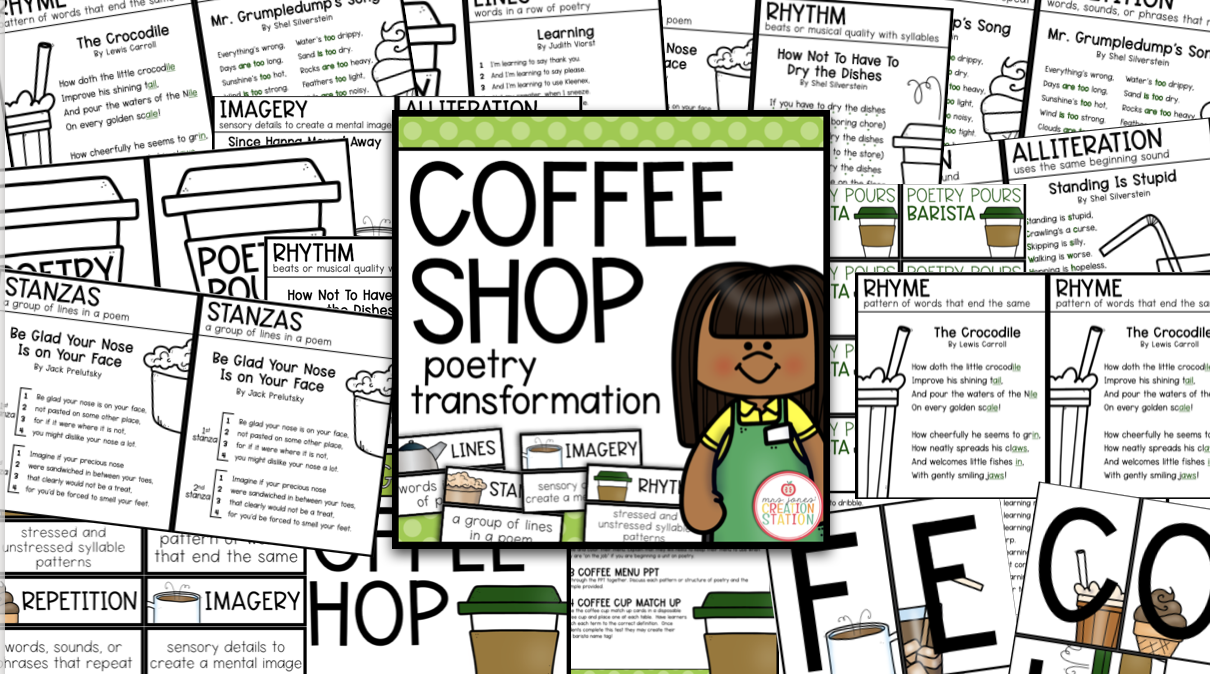
Poetry Teaching Examples
Students explore seven poetry concepts:
Lines
Words in a row of poetry
Stanzas
A group of lines in a poem
Rhythm
Beats or musical quality with syllables
Rhyme
A pattern of words that end the same
Repetition
Words, sounds, or phrases that repeat
Imagery
Sensory details that create a mental image
Alliteration
The use of the same beginning sound
Coffee Cup Match Up
After instruction, students complete the Coffee Cup Match Up again as a post-assessment.
Students match each poetry term to its definition, allowing you to quickly see how their understanding has changed from the beginning of the lesson.
Poetry Pours Barista Name Tags
Students can create their own Poetry Pours Barista name tags after completing their training.
It is a simple way to finish the transformation and celebrate their new poetry knowledge.
7 POETRY ELEMENTS INCLUDED
Lines
Students learn that lines are words arranged in a row of poetry.
The included example numbers individual lines so students can clearly see how a poem is structured.
Stanzas
Next, students learn how lines can be grouped into stanzas.
The example on page 11 visually identifies the first and second stanzas, making the structure easy for young readers to see.
Rhythm
Students explore the beats or musical quality created by syllables.
The included example visually marks the rhythm throughout the poem so students can connect the definition to actual text.
Rhyme
Students identify words with matching ending sounds.
The poetry example highlights rhyming words so students can see and hear the pattern.
Repetition
Students look for words, sounds, and phrases that repeat.
The repeated language is visually highlighted within the included example.
Imagery
Students learn how writers use sensory details to help readers create a mental image.
This provides a natural opportunity to discuss how poets help readers imagine what they see, hear, smell, taste, or feel.
Alliteration
Finally, students examine words that use the same beginning sound.
The example highlights repeated initial sounds so students can clearly see the pattern.
TRAIN • LEARN • PRACTICE • CELEBRATE
The Coffee Shop transformation follows a simple instructional progression.
1. Start Barista Training
First, introduce students to Poetry Pours.
Explain that they are training to become baristas and need to learn the poetry menu.
Students complete the Coffee Cup Match Up as a pre-assessment.
2. Build the Poetry Menu
Next, teach each poetry concept.
Students receive coordinating pages for their Poetry Pours Coffee Menu as you move through the lesson.
As a result, their menu becomes a poetry reference tool they can keep throughout the unit.
3. Complete the Coffee Cup Match Up
Then, bring back the vocabulary cards.
Students match the seven poetry terms with their definitions again.
You can compare their understanding with the beginning of the lesson or simply use the activity as a review.
4. Celebrate Your Baristas
Finally, students create their Poetry Pours Barista name tags.
Barista Training complete!
SKILLS COVERED
- Poetry
- Poetry vocabulary
- Poetry elements
- Poetry structure
- Lines
- Stanzas
- Rhythm
- Rhyme
- Repetition
- Imagery
- Sensory language
- Alliteration
- Figurative and descriptive language awareness
- Reading poetry
- Analyzing poetry
- Vocabulary development
- Matching terms and definitions
- Reading comprehension
- Literary text analysis
HOW TO USE
Poetry Classroom Transformation
First, decorate your classroom with the Second Grade Street Coffee Shop materials.
Next, introduce students to their Poetry Pours Barista Training.
Then, complete the vocabulary pre-assessment before beginning explicit poetry instruction.
As you introduce each poetry element, students build their Coffee Menu and study the coordinating examples.
Finally, complete the Coffee Cup Match Up again and celebrate your trained baristas.
Poetry Unit Introduction
This resource works especially well at the beginning of a poetry unit.
Use the pre-assessment to activate prior knowledge. Then, introduce the vocabulary students will encounter throughout the unit.
Students can keep their Poetry Pours menus nearby as reference tools during future lessons.
Poetry Review
Already taught the poetry elements?
Use the Coffee Shop transformation as a special review day.
Students can revisit each concept before completing the Coffee Cup Match Up.
Small Groups & Intervention
You can also pull individual poetry concepts for targeted instruction.
For example, focus on rhyme and rhythm with one group while another group works on identifying imagery or alliteration.
WHY TEACHERS LOVE IT
- Turns poetry vocabulary into an interactive experience
- Teaches seven important poetry concepts
- Includes explicit definitions
- Provides real poetry examples
- Includes a pre-assessment and post-assessment
- Creates a student poetry reference menu
- Includes an interactive vocabulary matching activity
- Makes abstract poetry terms easier to visualize
- Includes Coffee Shop classroom decor
- Works as a complete classroom transformation
- Can also be used without transforming the classroom
- Works for whole-group instruction
- Supports poetry review and intervention
- Gives students a reference they can use throughout the poetry unit
- Makes introducing poetry vocabulary feel like a special event
MORE THAN A COFFEE SHOP THEME
The coffee shop theme gets students interested, but poetry vocabulary and analysis are the focus.
For example, pages 10 through 16 provide a separate poetry example for each concept. Students can see numbered lines, clearly marked stanzas, visual rhythm cues, highlighted rhyming words, repeated language, sensory imagery, and repeated beginning sounds.
Students then collect those examples in their own Poetry Pours menu.
Therefore, the theme supports the instructional sequence instead of replacing it.
PERFECT FOR
- Second Grade Poetry
- Poetry Classroom Transformations
- Poetry Activities
- Poetry Vocabulary
- Poetry Elements
- Poetry Unit Introductions
- Poetry Review
- Poetry Comprehension
- Poetry Analysis
- Lines and Stanzas
- Rhythm and Rhyme
- Imagery
- Alliteration
- Repetition
- Whole-Group Reading
- Small-Group Reading
- Reading Intervention
- Literary Text Lessons
- Homeschool Poetry


Reviews
There are no reviews yet.