


Make second grade ELAR standards easier for students to understand
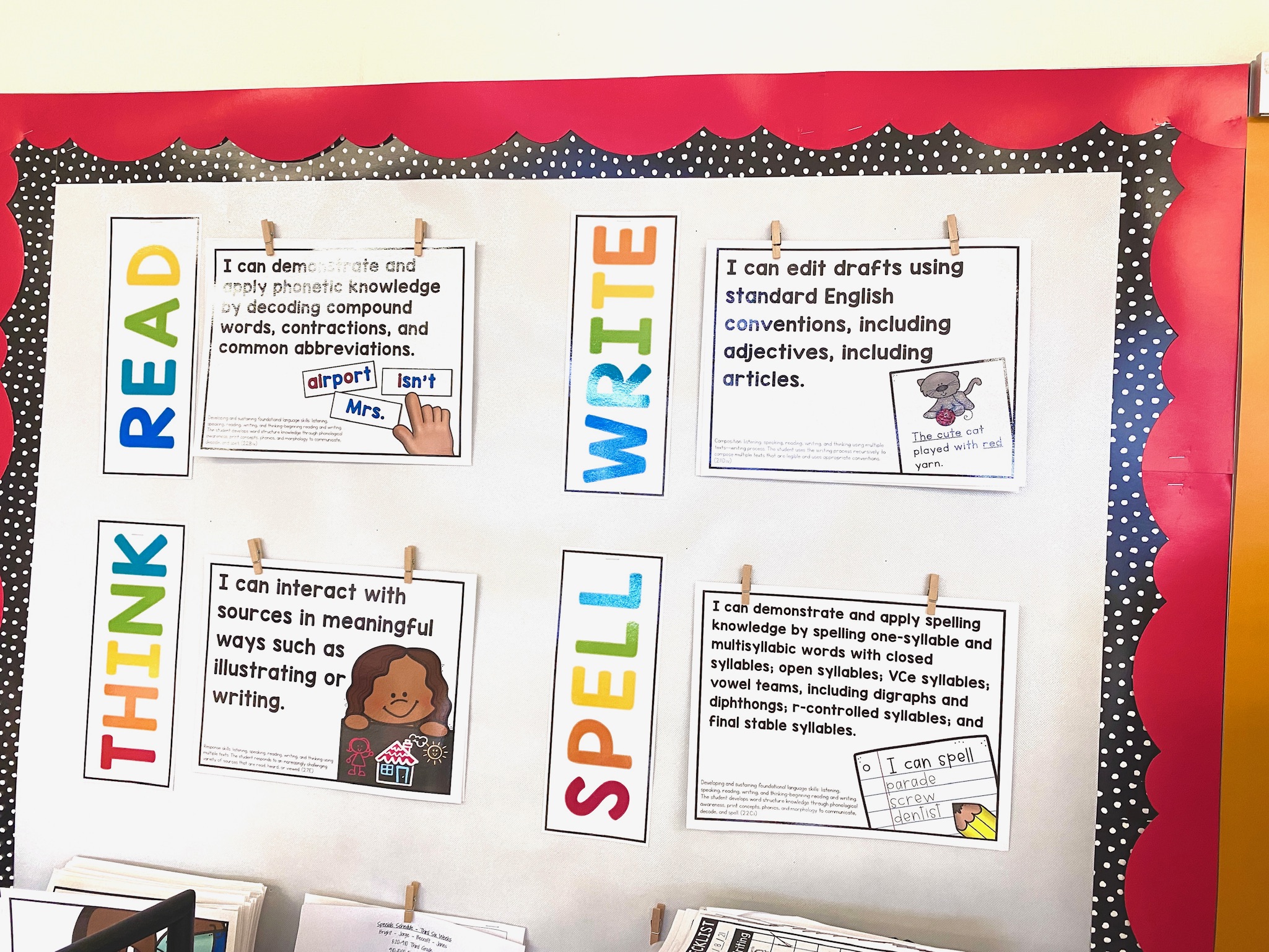
These Second Grade ELAR TEKS Visuals turn Texas English Language Arts and Reading standards into student-friendly I Can statements with colorful visual examples.
Instead of simply posting a TEKS code on the board, you can display a visual that helps students understand what they are actually learning. Each poster pairs a student-friendly learning statement with the corresponding Second Grade ELAR TEKS standard.
For example, students may see statements such as “I can make inferences and use evidence to support understanding” alongside a visual cue and TEKS 2.6.F. Other posters address text evidence, vocabulary, genre, setting, composition, research, and more.
As a result, teachers can make learning objectives more visible while giving students language they can understand and use.
These standards posters work well for learning targets, focus walls, classroom displays, lesson introductions, small groups, intervention, and standards-based instruction throughout the school year.
WHAT’S INCLUDED
Second Grade ELAR TEKS Visuals
The resource includes visual learning targets for Second Grade English Language Arts and Reading TEKS.
Each visual includes:
- Student-friendly I Can statement
- Corresponding ELAR skill
- TEKS standard reference
- Visual or picture support
- Classroom-friendly poster format
The visuals cover a wide range of second grade ELAR skills, allowing teachers to display the standard that matches current instruction.
Student-Friendly I Can Statements
Standards language can be difficult for young learners to understand. Therefore, each visual brings the learning goal to the forefront with an I Can statement.
Examples from the resource include:
- “I can establish purpose for reading assigned and self-selected texts.” (2.6.A)
- “I can make inferences and use evidence to support understanding.” (2.6.F)
- “I can use text evidence to support an appropriate response.” (2.7.C)
- “I can respond using newly acquired vocabulary as appropriate.” (2.7.F)
- “I can describe the importance of the setting.” (2.8.D)
- “I can compose literary texts, including personal narratives and poetry.” (2.12.A)
Visual Support for ELAR Skills
The posters use illustrations and examples to help make abstract standards more concrete.
For example, the poetry visual for TEKS 2.9.B asks students to explain visual patterns and structures in poems. Another visual addresses characteristics of well-known children’s literature, including folktales, fables, nursery rhymes, and fairy tales.
This makes the posters useful as more than standards documentation. Students can actually refer to them during instruction.
SKILLS COVERED
The Second Grade ELAR TEKS visuals support standards across areas such as:
- Foundational language skills
- Phonics and decoding
- Spelling
- Reading comprehension
- Metacognition
- Making inferences
- Using text evidence
- Vocabulary
- Response skills
- Literary elements
- Setting
- Genre
- Poetry
- Traditional literature
- Reading fluency
- Writing and composition
- Personal narratives
- Research and inquiry
- Gathering relevant information
- Speaking and listening
HOW TO USE
Learning Targets
First, choose the visual that matches the standard you are teaching.
Next, display it at the beginning of your lesson and read the I Can statement with students.
Then, briefly connect the visual to the day’s instruction.
Finally, return to the learning target at the end of the lesson to help students reflect on their progress.
Focus Wall
Display current standards on an ELAR focus wall.
As your instruction changes, switch the visuals so students and classroom visitors can quickly see the skills currently being taught.
Lesson Planning
Use the TEKS references to help connect daily instruction with required second grade ELAR standards.
Because the TEKS information appears directly on the visuals, you can quickly identify the standard connected with each student-friendly learning target.
Small Groups and Intervention
Display the appropriate visual during targeted reading or writing instruction.
For example, an inference poster can provide a clear learning target during a comprehension group, while a phonics or spelling visual can support targeted foundational skills instruction.
Classroom Observations
Keep your current learning objective visible during walkthroughs and observations.
Students have a clear statement explaining what they are learning, while the corresponding TEKS information provides the standards connection.
WHY TEACHERS LOVE IT
- Makes Second Grade ELAR TEKS more student-friendly
- Includes clear I Can statements
- Connects learning targets directly to TEKS
- Provides visual support for young learners
- Saves time creating standards posters
- Works with daily lesson objectives
- Makes learning goals visible
- Supports standards-based instruction
- Works for whole-group lessons
- Useful during small groups and intervention
- Helps organize ELAR focus walls
- Provides year-round classroom reference
- Makes it easier to discuss learning goals with students
GREAT FOR
- Second Grade ELAR
- Texas Teachers
- Second Grade TEKS
- ELAR TEKS
- I Can Statements
- Learning Targets
- Standards Posters
- Classroom Focus Walls
- Reading Objectives
- Writing Objectives
- Phonics Instruction
- Reading Comprehension
- Whole-Group Instruction
- Small Groups
- Intervention
- Classroom Observations
- Standards-Based Instruction
This resource is designed specifically around the Texas Essential Knowledge and Skills for Second Grade English Language Arts and Reading. Each visual connects a student-friendly learning statement with its corresponding TEKS standard.


Reviews
There are no reviews yet.