

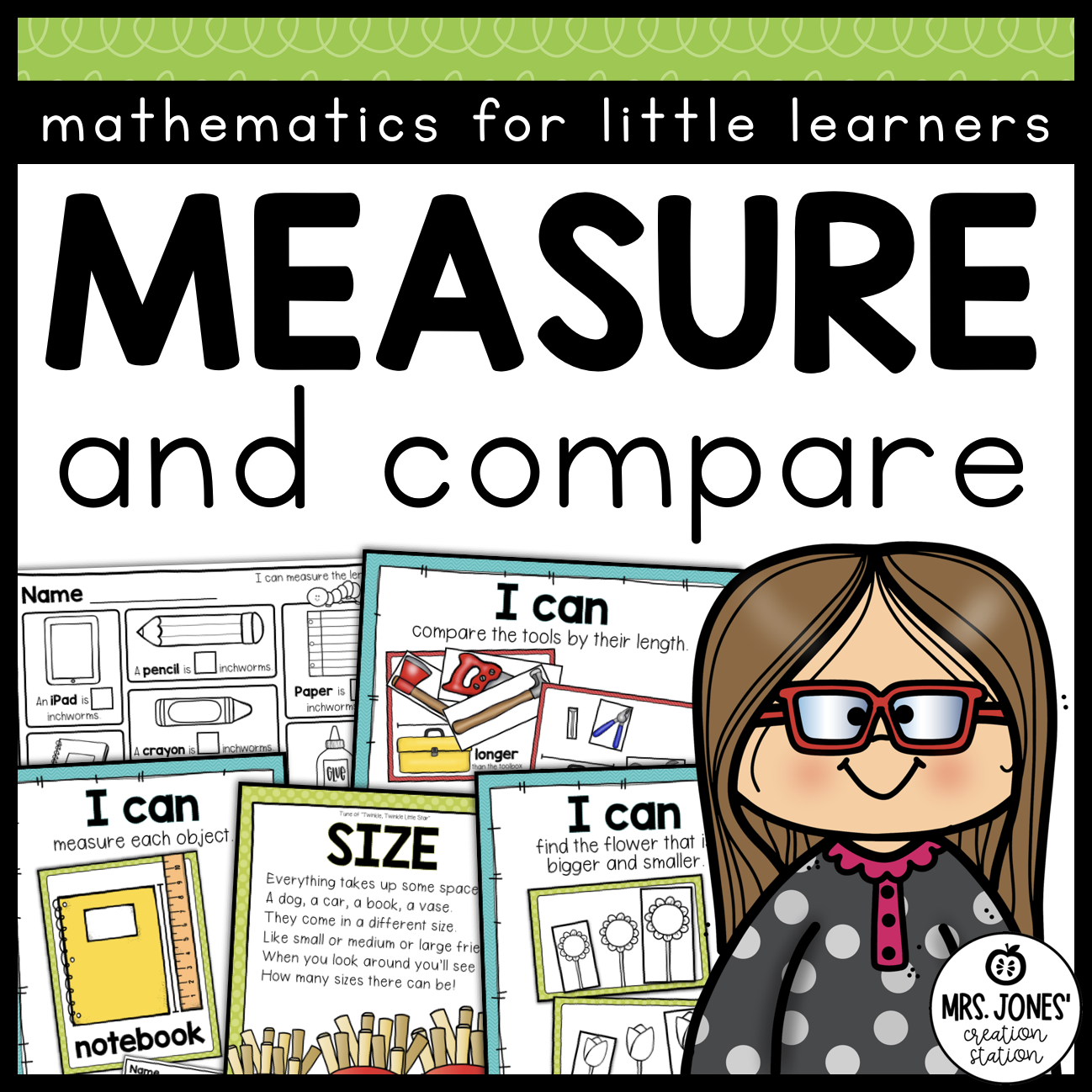


Explore Measurement, Graphing, Time, and Money with Hands-On Kindergarten Math
Make measurement meaningful with measurement activities for Kindergarten that connect math skills to real-life experiences. This comprehensive math unit includes 7 weeks of instruction with 35 lesson ideas, hands-on activities, math centers, vocabulary, songs, interactive pages, and assessment.
Students explore measurement by comparing size, length, weight, and capacity. Then, they apply measurement concepts while working with data and graphing, time, and money.
As a result, students do more than complete isolated practice pages. They measure classroom objects, compare attributes, collect and graph data, explore how long activities take, tell time, identify coins, and discuss how money is used.
Each week also includes a storytelling lesson that introduces the math skill through a real-life situation. Plus, read-aloud connections and hands-on activities give students multiple ways to explore each concept.
Use the unit for whole-group math, small groups, math centers, intervention, independent practice, and review.
WHAT’S INCLUDED
7 WEEKS OF MATH INSTRUCTION
The unit provides 35 lesson ideas organized into seven weeks of instruction.
Each week combines several types of learning experiences, including:
- Real-life storytelling lessons
- Measurement vocabulary
- Measurement songs
- Read-aloud connections
- Hands-on activities
- Interactive notebook practice
- Math centers
- Independent practice
MEASUREMENT VOCABULARY
Illustrated vocabulary cards help introduce and reinforce important math language throughout the unit.
Students build vocabulary as they describe, compare, measure, organize, and explain their mathematical thinking.
MEASUREMENT SONGS
Each week includes a coordinating song to introduce and review the measurement concept.
Use the songs during whole-group instruction, transitions, morning meeting, or quick math review.
STORYTELLING & REAL-LIFE MATH
Each week begins with a storytelling lesson based on a real-life measurement situation.
Students work with you to explore the problem and determine how measurement can help solve it.
READ-ALOUD LESSON CONNECTIONS
Three days each week include suggested read-alouds connected to the measurement skill.
After reading, students complete an activity that extends the concept through discussion and hands-on learning.
INTERACTIVE NOTEBOOK ACTIVITIES
Seven interactive notebook activities give students another way to practice and review the skills they learn.
These pages can also remain in students’ math notebooks for later reference and review.
MEASUREMENT READER
The How Can I Measure? reader introduces different types of measurement and ways we use measurement in everyday life.
HANDS-ON MATH CENTERS
Students apply their learning through a variety of math centers.
Activities include:
- Bigger or Smaller
- Order by Size
- Longer or Shorter
- Measuring Supplies
- Weight Clip Cards
- Heavy or Light
- Graphing Cubes
- Roll and Graph
- Clock Puzzles
- Second, Minute, or Hour
- Money Sort
- Needs and Wants
- Holds Less or Holds More
- How Many Spoons
SKILLS COVERED
Students practice:
- Comparing objects by size
- Ordering objects by size
- Comparing length
- Measuring length
- Using nonstandard measurement
- Comparing weight
- Identifying heavier and lighter objects
- Comparing capacity
- Identifying containers that hold more or less
- Collecting data
- Organizing data
- Creating graphs
- Interpreting graphs
- Comparing duration
- Understanding seconds, minutes, and hours
- Matching analog and digital clocks
- Telling time to the hour
- Identifying coins
- Sorting coins
- Understanding coin value
- Understanding needs and wants
- Exploring ways people earn and use money
GRAPHING ACTIVITIES
Students collect, organize, and represent data through hands-on graphing activities.
For example, the Graphing Cubes center has students grab a group of cubes and represent their results on a graph. The Roll and Graph activity provides additional practice collecting and recording data.
Students also practice explaining the information and results shown on a graph.
TIME ACTIVITIES
Students explore time as a form of measurement.
First, they compare how long different activities take. Next, they work with seconds, minutes, and hours.
Students also match analog and digital clocks and practice telling time to the hour.
Interactive clock activities provide additional visual and hands-on practice.
MONEY ACTIVITIES
Money lessons introduce coins through familiar, real-life situations.
Students practice:
- Identifying coins
- Sorting coins
- Exploring coin values
- Matching coins to their values
- Understanding why we use money
- Comparing needs and wants
- Discussing ways people earn money
In addition, the money lessons connect math concepts with practical financial vocabulary students encounter in everyday life.
HOW TO USE
First, introduce the week’s measurement concept with the storytelling lesson, vocabulary, and song.
Next, use the suggested read-alouds and hands-on activities to model the skill and provide guided practice.
Then, move students into small groups and math centers for additional application.
Students can complete the interactive notebook activity as they become more independent.
Finally, use the included assessment to check vocabulary, measurement concepts, graphing, time, and money skills.
WHY TEACHERS LOVE IT
- Includes 7 weeks of organized instruction
- Provides 35 lesson ideas
- Connects math to real-life situations
- Combines whole-group lessons and math centers
- Includes hands-on measurement experiences
- Builds important math vocabulary
- Integrates graphing, time, and money
- Includes songs and read-aloud connections
- Provides interactive notebook activities
- Works for small groups and intervention
- Includes assessment opportunities
- Gives students multiple ways to practice each skill
PERFECT FOR
- Kindergarten measurement
- Whole-group math lessons
- Small-group math
- Guided math
- Math centers
- Measurement activities
- Graphing activities
- Telling time practice
- Money activities
- Intervention
- Independent practice
- Math review
- Homeschool math
SAVE WITH THE YEARLONG MATH ACTIVITIES BUNDLE
This Measurement, Graphing, Time, and Money unit is included in the Yearlong Math Activities Bundle.
The bundle brings together hands-on Kindergarten math lessons, centers, small-group activities, independent practice, and assessment for foundational math skills throughout the school year.
If you want the coordinating math units for yearlong instruction, the bundle gives you the complete collection in one purchase.
WANT TO SEE IT IN ACTION?
Check out the preview to see examples of the measurement lessons, graphing activities, time practice, money activities, interactive pages, math centers, and assessments included in this resource.


Reviews
There are no reviews yet.