

Make Phonics Goals and Student Progress Visible
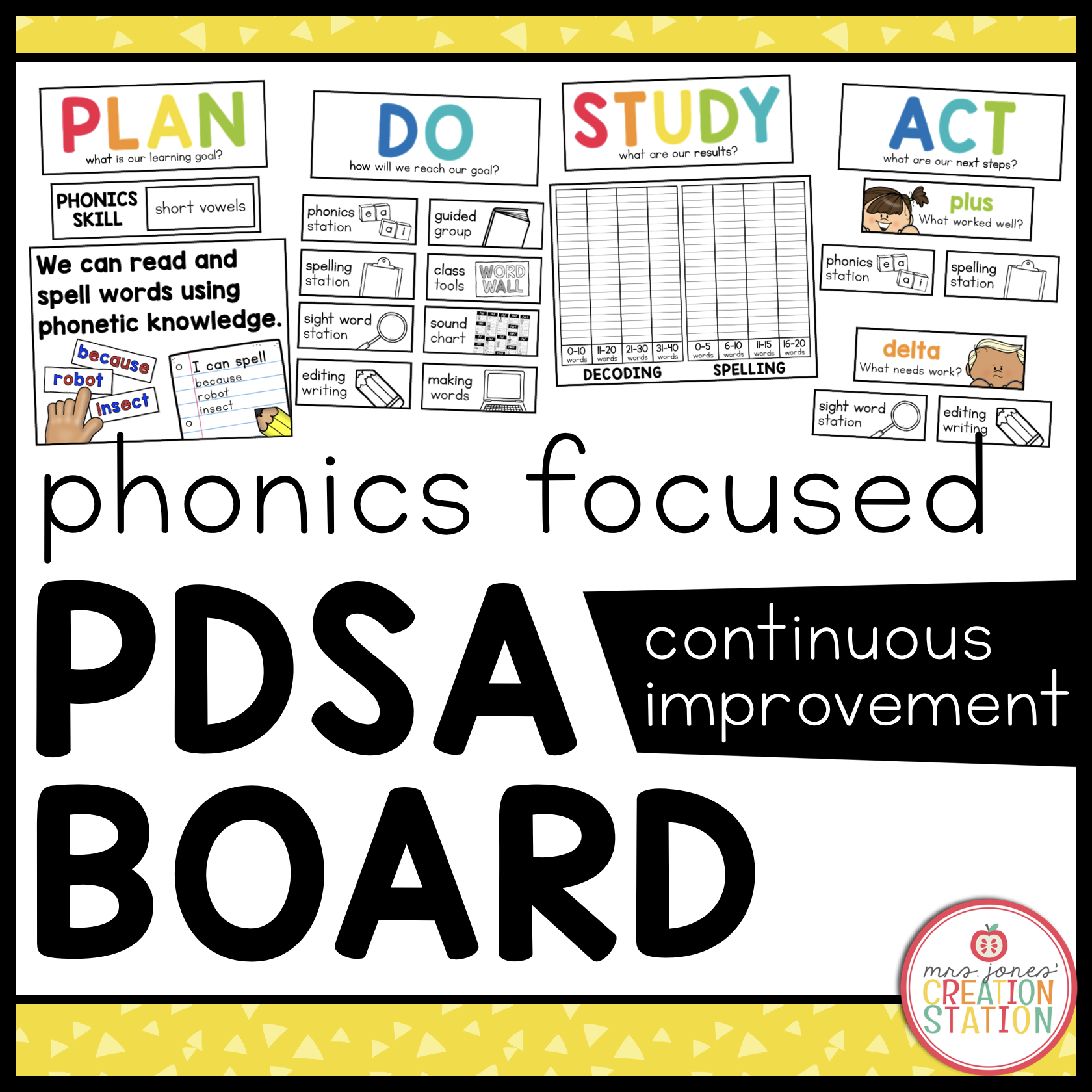
Create a clear classroom system for setting phonics goals, monitoring progress, and reflecting on instruction with this Phonics PDSA Board.
This resource uses the Plan, Do, Study, Act continuous improvement process to help teachers and students focus on a phonics skill, identify how they will work toward the goal, study decoding and spelling results, and determine their next steps.
First, choose the phonics skill your class is working on. Next, identify the instructional activities and classroom tools students will use. Then, track decoding and spelling results on the included data chart. Finally, reflect on what worked well and what still needs work.
As a result, phonics instruction becomes more visible and purposeful. Students can see what they are learning, how they are practicing, and how their progress connects to the next instructional step.
Use the pieces to create a classroom PDSA display that can change as your phonics instruction progresses throughout the year.
WHAT’S INCLUDED
PLAN, DO, STUDY & ACT HEADERS
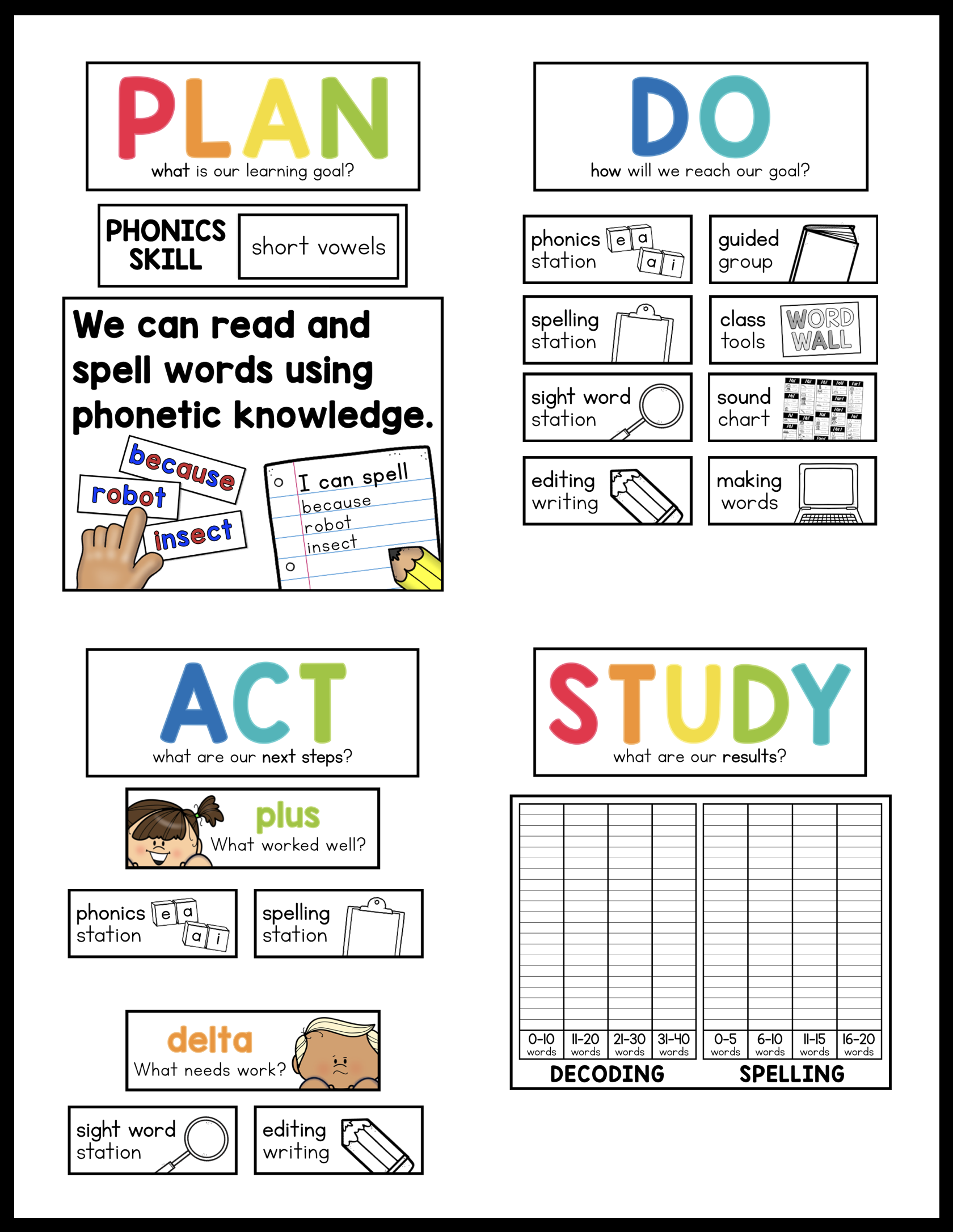
Build your classroom display around the four parts of the PDSA continuous improvement cycle:
PLAN: What is our learning goal?
DO: How will we reach our goal?
STUDY: What are our results?
ACT: What are our next steps?
The clear visual headings help organize the board so students can follow the learning process from goal setting through reflection.
PHONICS SKILL CARDS
Choose the phonics skill that matches your current instruction.
Included skills cover:
- Short vowels
- Long vowels
- Initial blends
- Consonant digraphs
- Ending blends
- Doublets
- Clusters and trigraphs
- R-controlled vowels
- VCe long vowels
- Vowel teams
- Diphthongs
- Long A variants
- Long O variants
- Long U variants
- Short O variants
- Schwa
- Silent letters
- Sounds of Y
- Hard and soft consonants
- Compound words
- Contractions
- Abbreviations
- Syllable division
- Syllable types
- Inflectional endings
- Prefixes
- Suffixes
- Open syllables
- Closed syllables
- Final stable syllables
This wide range of skills allows you to update the board as students move through your phonics scope and sequence.
PHONICS LEARNING GOAL
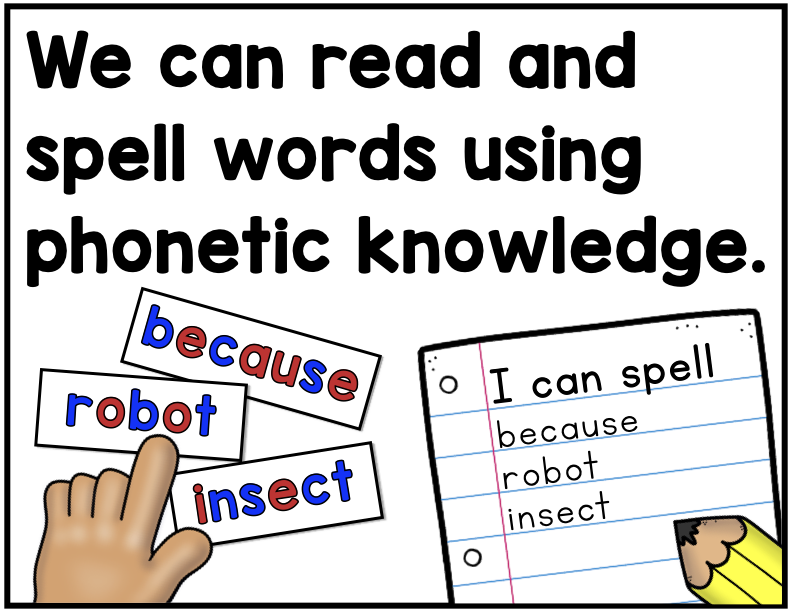
The resource includes the goal statement:
We can read and spell words using phonetic knowledge.
Use it as the larger learning goal while the phonics skill card identifies the specific skill students are currently practicing.
DO CARDS
Show students how they will work toward their phonics goal.
The included instructional and practice cards are:
- Phonics station
- Guided group
- Spelling station
- Class tools
- Sight word station
- Sound chart
- Editing writing
- Making words
For example, you might select phonics station, guided group, sound chart, and making words as the strategies students will use during the current learning cycle.
DECODING & SPELLING DATA CHART
Track class progress in two important areas: decoding and spelling.
The decoding chart includes ranges for:
- 0 to 10 words
- 11 to 20 words
- 21 to 30 words
- 31 to 40 words
The spelling chart includes:
- 0 to 5 words
- 6 to 10 words
- 11 to 15 words
- 16 to 20 words
Use the chart during the Study portion of the PDSA cycle to make class progress visible.
PLUS & DELTA REFLECTION
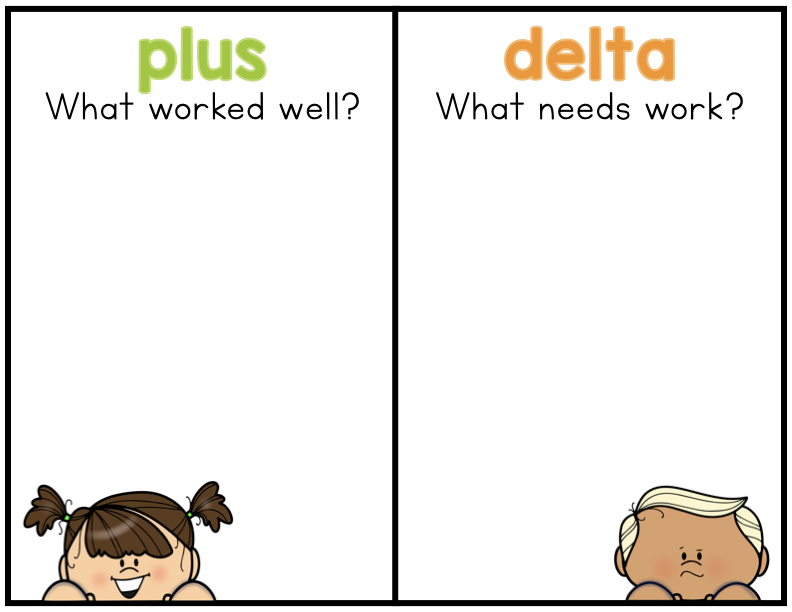
Help students reflect on the learning cycle with two simple prompts:
Plus: What worked well?
Delta: What needs work?
These reflection pieces support meaningful classroom conversations about strategies, progress, and next steps.
ACT CARDS
After studying the results, decide what comes next.
The Act cards use the same instructional options as the Do cards. Therefore, you can identify strategies that should continue, change, or receive additional attention during the next learning cycle.
SKILLS & CLASSROOM PRACTICES SUPPORTED
- Phonics goal setting
- Decoding
- Spelling
- Phonics skill development
- Student reflection
- Progress monitoring
- Classroom data tracking
- Student ownership of learning
- Goal-focused instruction
- Instructional reflection
- Continuous improvement
- Data-informed instruction
HOW THE PDSA CYCLE WORKS
Plan: Select the phonics skill and establish the learning goal.
Do: Choose the stations, small-group instruction, tools, and activities students will use to work toward the goal.
Study: Record and discuss decoding and spelling results.
Act: Identify what worked well, determine what needs work, and choose the next instructional steps.
Then, begin a new cycle with the next phonics goal or continue working on the current skill based on student needs.
HOW TO USE
First, display the Plan, Do, Study, and Act headings on a bulletin board, whiteboard, or classroom wall.
Next, choose the phonics skill that matches your current instruction.
Then, select the Do cards that show how students will practice the skill.
As students work toward the goal, collect decoding and spelling data. Add the results to the Study chart so students can see class progress.
Finally, discuss the Plus and Delta prompts. Decide which strategies worked well and what needs additional practice before choosing your next steps.
Use this Phonics PDSA Board for:
- Phonics instruction
- Classroom data walls
- Continuous improvement classrooms
- Student goal setting
- Progress monitoring
- Decoding practice
- Spelling instruction
- Student reflection
- Whole-group phonics
- Classroom meetings
- Data discussions
- Instructional planning
WHY TEACHERS LOVE IT
- Organizes the PDSA cycle in a student-friendly format
- Designed specifically for phonics instruction
- Includes a wide range of phonics skill cards
- Makes learning goals visible
- Connects classroom activities with learning goals
- Tracks both decoding and spelling
- Encourages students to reflect on their learning
- Includes Plus and Delta reflection prompts
- Supports data-informed instructional decisions
- Can change with your phonics scope and sequence
- Provides reusable pieces for multiple learning cycles
- Makes progress monitoring part of everyday instruction


Reviews
There are no reviews yet.