

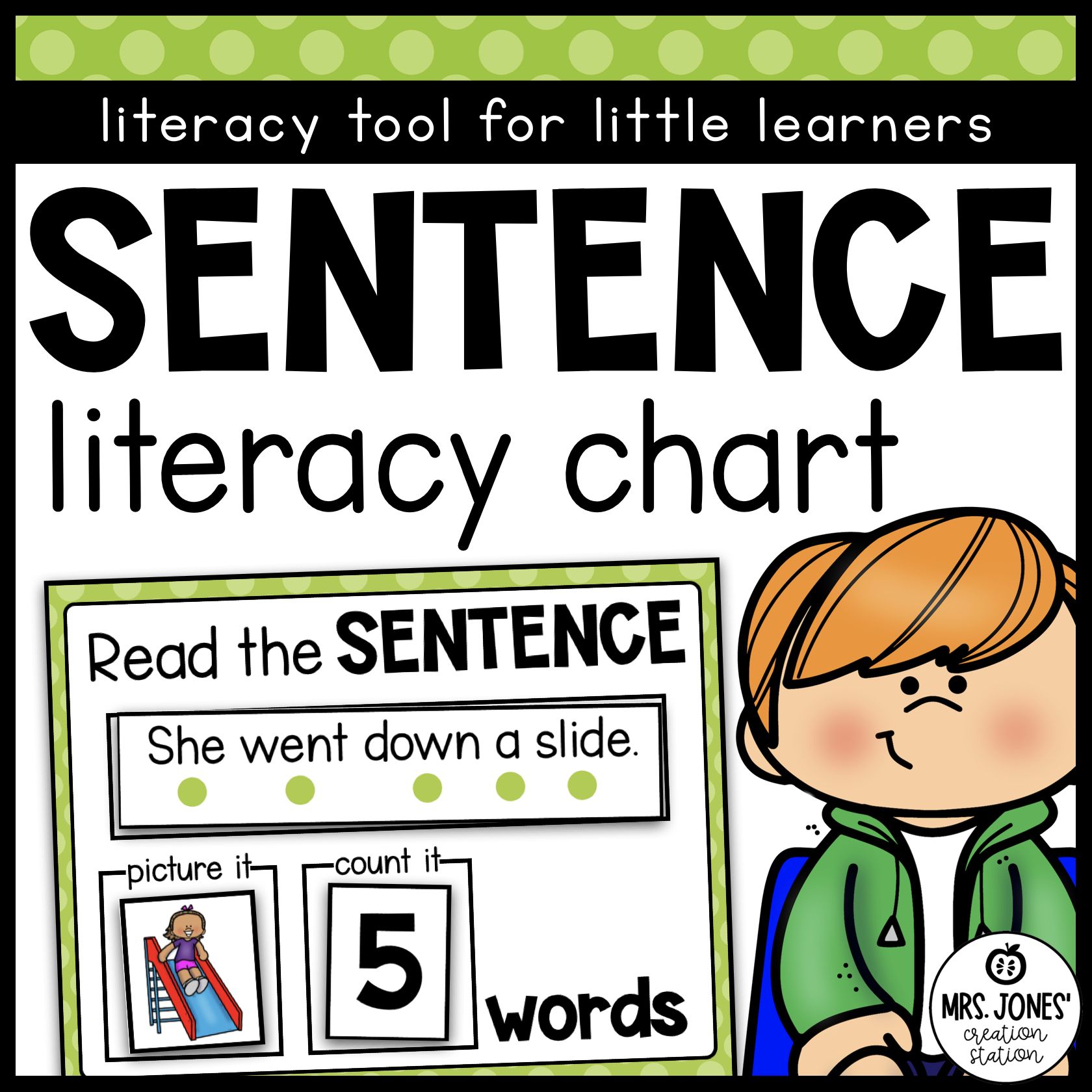
Build sentence reading and concepts of print during whole-group literacy
This Sentence Literacy Chart gives beginning readers an interactive way to explore how sentences work during morning meeting, whole-group literacy instruction, small groups, or intervention.
Students read a sentence, track each word, match the sentence with a coordinating picture, and determine how many words are in the sentence. As a result, students practice important concepts of print while also building early reading skills.
Each sentence strip includes a green dot beneath every word. Students can point to the dots as they read, helping them see that spoken sentences are made up of individual printed words. Then, they choose a matching picture and identify the total number of words in the sentence.
The included sentences range from short examples such as She can sing. and Bees buzz. to longer sentences such as I can pick a red apple. and They ride the bus to school. This variety gives you opportunities to model sentence reading with different sentence lengths.
Plus, the predictable “Read the Sentence, Picture It, Count It” routine makes this an easy literacy activity to revisit throughout the year.
See how I use literacy charts during morning meeting
WHAT’S INCLUDED
“Read the Sentence” Literacy Chart
The reusable literacy chart includes three main components:
- Read the Sentence space for a sentence strip
- Picture It space for the coordinating picture
- Count It space for the number of words
Students read the sentence, identify the matching picture, and count the individual words.
40 Sentence Strips
The resource includes 40 sentence strips for repeated reading and concepts of print practice.
Each sentence strip includes:
- A complete sentence
- Clear beginning-reader text
- A green dot beneath each individual word
- Capitalization at the beginning
- Ending punctuation
For example, students might read:
I like to read books.
Raise your hand.
She went down a slide.
The squirrel eats nuts.
The little bird is blue.
The dots provide a visual cue that helps students track one printed word at a time as they read.
Coordinating Picture Cards
Colorful picture cards coordinate with the sentences.
After reading, students select the picture that best represents the sentence and place it in the Picture It section of the chart.
This adds a comprehension component because students need to think about what the sentence means rather than simply decoding the words.
Number Cards
Number cards 1 through 7 are included for the “Count It” portion of the activity.
Students count the words in the sentence and choose the corresponding number card.
This reinforces the idea that a sentence is made up of separate words, even when those words are spoken together naturally.
SKILLS COVERED
- Concepts of print
- Sentence reading
- One-to-one word correspondence
- Tracking print from left to right
- Identifying individual words in sentences
- Counting words in sentences
- Sentence comprehension
- Picture-to-sentence matching
- Beginning capitalization
- Ending punctuation
- Oral reading
- Reading fluency
- High-frequency word recognition
- Early reading comprehension
READ IT • PICTURE IT • COUNT IT
This chart uses a simple three-part routine that makes sentence structure more concrete for beginning readers.
Read It
First, place a sentence strip on the chart.
Read the sentence together while pointing to each green dot. Encourage students to match one spoken word with one printed word.
Picture It
Next, discuss what the sentence means.
Students choose the picture that best represents the sentence and place it in the Picture It section.
For example, if the sentence says She went down a slide, students locate the corresponding picture of a child on a slide.
Count It
Then, count the words.
Students can touch or point to each green dot while counting. Afterward, they choose the correct number card and place it in the Count It section.
This routine helps students connect spoken words, printed words, sentence meaning, and word count in one activity.
HOW TO USE
Morning Meeting
First, display the Sentence Literacy Chart where everyone can see it.
Next, choose one sentence strip and read it together.
Then, point to each green dot while students reread the sentence with you.
Ask students to choose the picture that matches the meaning of the sentence.
Finally, count the words together and select the correct number card.
The entire routine can provide a quick literacy review without taking over your morning meeting.
Whole-Group Literacy Instruction
Use the chart when explicitly teaching concepts of print.
For example, model how a sentence begins with a capital letter and ends with punctuation. Then, demonstrate how spaces separate the individual words.
You can also use the dots to model one-to-one correspondence as students track the sentence from left to right.
Small Groups & Intervention
Use selected sentence strips when students need additional support with tracking print or understanding word boundaries.
First, read the sentence aloud together. Next, have students touch each dot as they repeat the sentence.
Then, ask students to count the words independently.
Finally, discuss the meaning of the sentence and choose the matching picture.
The consistent routine allows you to provide repeated practice without introducing a new activity every time.
WHY TEACHERS LOVE IT
- Makes concepts of print interactive
- Includes 40 sentence strips
- Uses one dot for each printed word
- Supports one-to-one word correspondence
- Helps students understand word boundaries
- Combines reading with comprehension
- Includes colorful picture support
- Adds word-counting practice
- Reinforces capitalization and punctuation
- Works naturally during morning meeting
- Supports whole-group instruction
- Provides targeted intervention practice
- Uses a predictable routine students can quickly learn
- Makes quick literacy review easy to fit into the school day
MORE THAN JUST READING A SENTENCE
Beginning readers sometimes hear a sentence as one continuous stream of language.
This activity helps make the individual words visible.
For example, when students read I like to read books, they can point to five dots while saying five separate words.
Next, they count those words and choose the number 5.
Then, they connect the printed sentence with its meaning by choosing the picture of a child reading.
As a result, one short sentence provides practice with print tracking, word boundaries, comprehension, and sentence structure.
PERFECT FOR
- Morning Meeting
- Whole-Group Literacy
- Concepts of Print Lessons
- Beginning Reading
- Sentence Reading
- Kindergarten Literacy
- Pre-K Literacy
- Small-Group Instruction
- Reading Intervention
- Early Reading Intervention
- Daily Literacy Review
- Homeschool Reading Instruction
SAVE WITH THE LITERACY MORNING MEETING CHARTS BUNDLE
Love using interactive literacy charts for whole-group instruction?
This Sentence Literacy Chart is included in the Literacy Morning Meeting Charts Bundle, which gives you additional interactive charts for practicing early literacy skills throughout the school year.
Use the charts during morning meeting, whole-group literacy instruction, small groups, or intervention to create a predictable instructional routine while changing the literacy skill being practiced.
WANT TO SEE IT IN ACTION?
Want to see how literacy charts can fit into your classroom routine?
I use literacy charts to bring quick academic practice into morning meeting while keeping students involved in the learning. Students can read, discuss, count, and help complete the chart together.


Reviews
There are no reviews yet.